
Losing a tooth can leave you with an important decision: how should the missing tooth be replaced?
Two commonly discussed options are a dental bridge and a dental implant. Both can help replace a missing tooth, but they use different forms of support and may fit different dental situations.
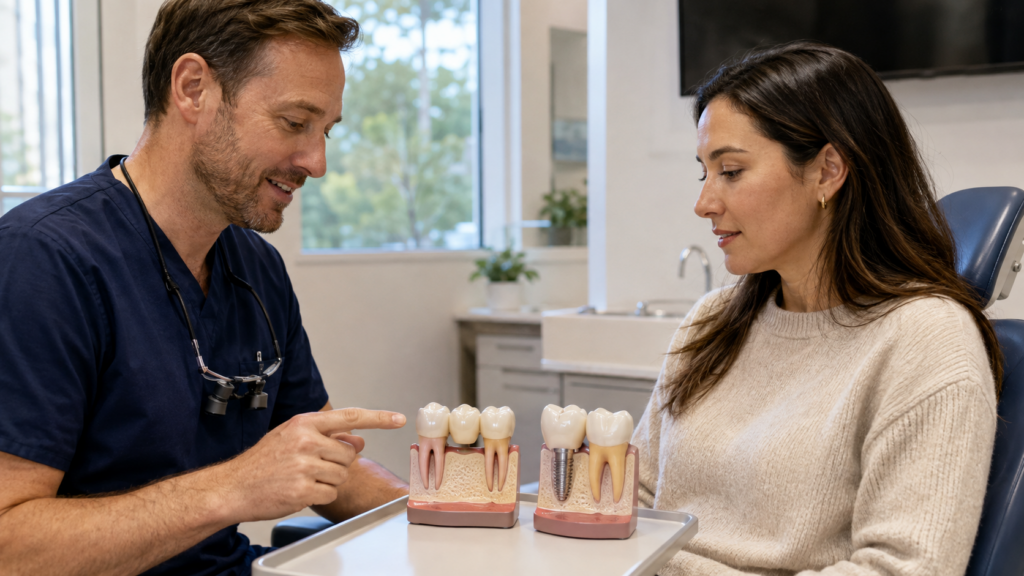
A traditional dental bridge typically relies on neighboring teeth for support. A dental implant uses an implant placed in the jaw to support a replacement tooth or restoration.
So, which option is right for you?
There is no universal answer. Your dentist needs to consider your oral health, surrounding teeth and tissues, anatomy, treatment goals, and other individual factors before recommending an approach.
At Butler Hill Dental, treatment planning is centered on understanding each patient’s needs and clearly explaining the available options.
What Is a Dental Bridge?
A dental bridge replaces a missing tooth or space with a dental restoration supported by neighboring teeth.
The replacement tooth is called a pontic. Depending on the type of bridge and the individual situation, teeth beside the missing space may provide support for the restoration.
Because those neighboring teeth are part of the treatment plan, their condition matters.
Your dentist needs to evaluate whether the supporting teeth and surrounding mouth are appropriate for a bridge before recommending one.
What Is a Dental Implant?
A dental implant uses an implant placed into the jaw to support a replacement tooth or another restoration.
Unlike a traditional bridge, this type of replacement does not rely on neighboring teeth for support in the same way.
Implant treatment does, however, require individualized planning.
Your dentist may consider:
- Available bone
- Gum and oral health
- Anatomy
- Medical history
- Location of the missing tooth
- Surrounding teeth and tissues
- Treatment goals
A dental implant may be appropriate for some patients, but candidacy should be determined through a comprehensive evaluation.
Dental implant placement is confirmed at Butler Hill Dental, although the practice should remain positioned as a general dental office rather than an implant specialty practice.
Dental Bridge vs. Dental Implant: What Are the Main Differences?
The most basic difference is how each replacement is supported.
| Factor | Traditional Dental Bridge | Dental Implant |
| Support | Typically supported by neighboring teeth | Supported by an implant placed in the jaw |
| Neighboring teeth | Their condition and suitability are important to the restoration | They are not used for support in the same way |
| Bone | Does not require implant placement into the jaw | Available bone and surrounding tissues are important to candidacy |
| Surgical implant placement | Not part of a traditional bridge | Part of implant treatment |
| Treatment sequence | Depends on the bridge and supporting teeth | Depends on anatomy, treatment needs, healing, and restoration planning |
| Maintenance | Requires cleaning around and beneath the bridge | Requires ongoing oral hygiene and dental monitoring |
These distinctions help explain the treatments, but they do not identify a universal winner.
The appropriate option depends on the individual patient’s dental situation.
How Do Neighboring Teeth Affect the Decision?
The condition of the teeth beside the missing space can be particularly important when considering a traditional bridge.
Those teeth need to provide appropriate support for the restoration.
If neighboring teeth already have significant restorative needs, that can also influence the treatment discussion.
An implant does not rely on adjacent teeth for the same type of support. However, this does not automatically make an implant the better option.
Your dentist still needs to assess the complete situation, including the condition of the neighboring teeth, gums, bone, and overall mouth.
How Does Bone Health Affect Dental Implant Planning?
Because an implant is placed in the jaw, available bone and the condition of the surrounding tissues are important parts of treatment planning.
Some patients may have enough appropriate bone for implant treatment, while others may need additional evaluation or treatment before implant placement can be considered.
An implant therefore should not be assumed to be appropriate simply because a tooth is missing.
Your dentist needs to evaluate anatomy, oral health, medical history, and other individual factors.
Does a Dental Bridge Require Surgery?
A traditional dental bridge does not involve surgical implant placement into the jaw.
However, the neighboring teeth used to support the bridge may need preparation so the restoration can fit properly.
The exact treatment process depends on the type of bridge and the condition of the supporting teeth.
Your dentist can explain what would need to happen in your individual case before you choose a treatment.
Is an Implant Always Better Than a Bridge?
No.
Dental implants can be a useful tooth-replacement option for selected patients, but that does not make them universally better than bridges.
A bridge may make sense when the neighboring teeth are appropriate for support and the overall treatment circumstances favor that approach.
An implant may be considered when the patient is an appropriate candidate for implant treatment and an independently supported replacement fits the treatment plan.
The decision should be based on oral health, anatomy, treatment needs, goals, and preferences rather than the idea that one treatment is automatically more advanced or desirable.
Which Option Takes Less Time?
Treatment timing varies.
A bridge and implant involve different treatment processes, and the total sequence can depend on the patient’s oral health, necessary preparation, healing, and the restoration being provided.
Implant treatment may include stages related to placement and healing, while bridge treatment involves evaluation and preparation of the supporting teeth.
Rather than relying on a general timeline, ask your dentist what the expected sequence would look like for your specific treatment plan.
How Do You Care for a Bridge or Implant?
Neither option is maintenance-free.
A bridge requires regular brushing and careful cleaning around and beneath the restoration. Routine professional dental care also remains important.
Dental implants likewise require good oral hygiene and continued dental monitoring.
Your dental team can explain how to clean the specific restoration and surrounding tissues based on the treatment you receive.
Long-term care should be part of the conversation before choosing either option.
What If I Am Not a Candidate for a Dental Implant?
An implant is not the only option for replacing missing teeth.
Depending on your circumstances, a dental bridge may still be considered. For patients with different patterns of tooth loss, dentures may also be part of the broader treatment discussion.
The appropriate option depends on the number and location of missing teeth, remaining teeth, surrounding tissues, oral health, and individual preferences.
The goal is to identify a replacement approach that fits the overall dental situation rather than assuming every patient should receive the same treatment.
What If the Tooth Has Not Been Removed Yet?
Sometimes the tooth being discussed cannot reasonably be maintained and may need to be removed before replacement is planned.
Butler Hill Dental provides tooth extractions as one of its confirmed services.
Extraction and replacement do not automatically happen at the same appointment.
For example, implant timing can depend on healing, anatomy, surrounding tissues, and whether additional treatment is needed.
Your dentist can explain the appropriate sequence based on the condition of the tooth and the replacement being considered.
Why Does a Dentist Evaluate More Than the Missing Tooth?
Replacing a tooth should fit into the health and function of the rest of the mouth.
Your dentist may consider:
- Neighboring teeth
- Bite and function
- Gum health
- Available bone
- Existing restorations
- Other missing teeth
- Overall oral health
This broader evaluation helps determine whether a bridge, implant, or another option fits the patient’s overall needs.
It is especially important when several dental concerns are present at the same time.
What Questions Should You Ask Before Choosing?
You should feel comfortable asking why one replacement is being recommended over another.
Helpful questions include:
- Why do you recommend a bridge or implant for me?
- Are the neighboring teeth suitable for a bridge?
- Is my bone and oral health appropriate for an implant?
- What preparation would each option involve?
- What would the treatment sequence look like?
- How would I care for the restoration?
- Are other tooth-replacement options appropriate?
- What factors make one option better suited to my situation?
Clear answers can help you understand the recommendation instead of choosing based only on general comparisons.
The Right Choice Depends on the Patient
A dental bridge and dental implant can both provide ways to replace missing teeth, but they are not interchangeable treatments.
A traditional bridge uses neighboring teeth for support. An implant uses an implant placed in the jaw and requires appropriate anatomy and oral health.
The condition of surrounding teeth, available bone, treatment sequence, oral health, number of missing teeth, goals, and preferences can all affect the recommendation.
There is no need to treat the decision like a contest between an old option and a new one.
The better question is which approach appropriately fits the patient’s current dental needs and long-term treatment plan.
Personalized Tooth-Replacement Planning at Butler Hill Dental
Butler Hill Dental has served South St. Louis County for more than 40 years and emphasizes locally owned, patient-first dentistry built around listening, comfort, personalized care, and lasting relationships.
When replacing a missing tooth, patients should understand why a bridge, implant, or another option is being considered and what the treatment would involve.
If you have a missing tooth and want to understand your options, contact Butler Hill Dental to schedule an evaluation and discuss which approach may fit your needs.



